Twitter

Wednesday, May 5, 2010

Old Jerusalem


I took these pictures of Jerusalem when we went to the Mount of Olive.


The Wall of Jerusalem surrounding the Old City and the Damacus Gate that led to the bazaar and the Via Dolorosa.


Written in Hebrew, Arabic and English. The Via Dolorosa is the path that Jesus walked while carrying his cross. It is now one of the most crowded bazaars in the world.


The Church of the Holy Sepulchre is twice as large as the Basilica of St. Peter in Rome. It was built in 326 AC by Emperor Constantine at the site where the three crosses were found. In 638, the Christians were forced to surrender Jerusalem to Muslim control under caliph Omar. In a remarkable gesture for the time, Omar refused to pray in the Church of the Holy Sepulchre, saying, "If I had prayed in the church it would have been lost to you, for the Believers [Muslims] would have taken it saying: Omar prayed here." This act of generosity would have unfortunate consequences, however.

The Church of the Holy Sepulchre continued to function as a Christian church under the protection of Omar and the early Muslim rulers, but this changed on October 18, 1009, when the "mad" Fatimid caliph Hakim brutally and systematically destroyed the great church.

Ironically, if Omar had turned the church into a mosque, Hakim would have left it alone. But instead, Hakim had wrecking crews knock over the walls and he attacked the tomb of Christ with pricks and hammers, stopping only when the debris covered the remains. The east and west walls were completely destroyed, but the north and south walls were likely protected by the rubble from further damage.


The mausoleum harboring the tomb of Christ and the second floor built on the Golgota.


The Christian community of Jerusalem could not afford repairs, but in 1048 Emperor Constantine Monomachos provided money for reconstruction, subject to stringent conditions imposed by the caliphate. This was the church to which the knights of the First Crusade arrived to sing their Te Deum after capturing Jerusalem on July 15, 1099. The Crusader chief Godfrey of Bouillon, who became the first king of Jerusalem, declared himself Advocatus Sancti Sepulchri, "Defender of the Holy Sepulchre."

Subsequent centuries were not altogether kind to the Church of the Holy Sepulchre. It suffered from damage, desecration, and neglect. Another caliph turned it into a Moslem school.

Not until 1959 did the three major communities (Latins, Greeks, Armenians) agree on a major renovation plan. The church's chaotic history is evident in what visitors see today. Byzantine, medieval, Crusader, and modern elements mix in an odd mish-mash of styles, and each governing Christian community has decorated its shrines in its own distinctive way. In many ways, the Church of the Holy Sepulchre is not what one would imagine for the holiest site in all Christendom. But at the same time, its noble history and immense religious importance is such that a visit can also be very meaningful.

Wednesday, April 28, 2010

Luxor: Capital of the Pharaohs


We spent two days in Luxor walking or rather rushing from one temple to another until I begged our guide to slow down. We could have easily spent four days for a more relaxed tour of the monuments.
[Click on pictures to enlarge]


We also attended a sound and light show at the temple of Karnak.


In the time of the Pharaohs, Luxor was called Thebes, the most important capital of the civilized world.


In addition to the Temple of Luxor and the Temple of Karnak, Luxor boasts the famous Valley of the King that harbored more seventy tombs, including the tomb of Tutankhamen—famous King Tut. It is assumed that many more tombs are still hidden under the desert in this area. We visited four of the tombs going down the steps under the rock to admire the incredibly well preserved sculptured and painted walls. Unfortunately we were
not allowed to take pictures.


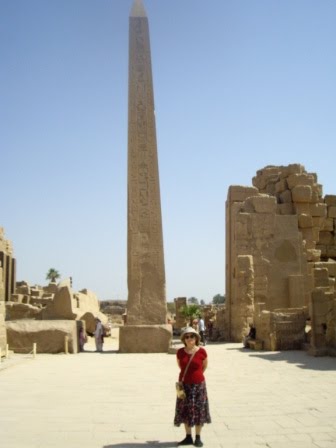
The Temple of Luxor—dedicated to Horus, the falcon-headed god-- was connected to the temple of Karnak by a causeway of sphinx.


The temple of Luxor was built by Amenhotep III and later by Ramses II and had two obelisks. One of them was donated by Egyptian ruler, the great Mohamed Aly to France and is now in the Place de la Concorde in Paris in 1819.

The temple of Karnak was built 2000 years ago. It consists of ten pylons and four courtyards. The Hypostyle has 134 columns.


Many festivals were celebrated in Thebes such as the festival of Opet. The festival itself was to reconcile the human aspect of the ruler with the divine office. The festival lasted eleven days, but had grown to twenty-seven days by the reign of Ramses III. At that time the festival included the distribution of over 11,000 loaves of bread, 85 cakes and 385 jars of beer.


The procession of images of the current royal family began at Karnak and ended at the temple of Luxor. The journey was being made by barge, on the Nile River. Each god or goddess was carried in a separate barge that was towed by smaller boats. Large crowds consisting of soldiers, dancers, musicians and high ranking officials accompanied the barge by walking along the banks of the river.


During the festival the people were allowed to ask favors of the statues of the kings or to the images of the gods that were on the barges.


If you like to travel and love to read, come and enjoy my international romances. I will take you around the world through stories that simmer with emotion and sizzle with heat~

BABIES IN THE BARGAIN, winner of 2009 BEST contemporary romance at READERS FAVORITE and 2009 BEST ROMANCE NOVEL at Preditors & Editors Readers Poll.
Rx FOR TRUST: 5 stars at Readers Favorite.

Monday, April 26, 2010

Queen Hatshepsut

In the old city of Thebes, the capital of strong kings and rulers called Pharaohs, an unthinkable thing happened in 1515 B.C., a mere female seized the throne. She dressed as a man, built a temple and had the people honor her as Pharaoh.

Queen Hatshepsut is the only female Pharaoh to have ruled over Egypt. When her father, Pharaoh Tuthmoses I died, her younger brother, Tuthmoses II, became Pharaoh. In Ancient Egypt, the women couldn't reign but tradition had it that only the women in Egypt carried the royal blood, not the males.


(Hatchepsut built this temple to the goddess Isis, goddess of fertility. She represented herself as a male Pharaoh.)


(Below: Pharaoh presening gifts to the god Horus (with the head of a falcon.) This god guided the dead to the afterlife in the boat of death. The colors are still
great after 3500 years and were made with egg white.
To become Pharaoh, the man had to marry a female of royal blood, often a sister. Tuthmoses II married Hatshepsut, gave her a daughter, and died young. His son by another wife, Tuthmoses III, was still a child.

Hatshepsut became regent. They ruled together for a number of years until she proclaimed herself Pharaoh, something almost unheard of, despite the higher status of women in Egypt compared to women in other cultures at the time.
Before Hatshepsut, there were queens who had ruled Egypt... but not a female Pharaoh.
(Here Hatshepsut dressed as a male Pharaoh).
She managed to rule for about twenty years, before disappearing from history... coinciding with Thuthmose III's becoming Pharaoh in his own right. He erased her name from all the scriptures.

Later, the Christian monks built the monastery of Deir El Bahari, next to Hatshepsut's Temple.


If you like to travel and love to read, come and enjoy my international romances. I will take you around the world through stories that simmer with emotion and sizzle with heat~

BABIES IN THE BARGAIN, winner of 2009 BEST contemporary romance at READERS FAVORITE and 2009 BEST ROMANCE NOVEL at Preditors & Editors Readers Poll.
Rx For Trust: 5 stars at Readers Favorite.

Friday, April 23, 2010

The Colossi of Memnon


My husband and I have just returned from a fantastic trip to the Middle East. We visited Jordan, Israel, Palestine and Egypt. It was exhausting to say the least but so worth the trouble. After a twelve hour flight, we landed in Amman, Jordan, spent three days there, drove to Israel to spend the Holy Week and Easter in Jerusalem. From there we flew to Cairo and then to Louxor, an hour south of Cairo by plane, to cruise the Nile River from Louxor to Aswan.


Louxor is situated in the South of the Valley of the Nile, called Upper Egypt. Temperatures range from 65 in the morning to 100 oF at 2 pm. We started our tours at 6 am to be back to our cruise boat (a small ship that can host 100 guests)before the smoldering heat of noon. In Louxor, our first visit includded the awesome Colossi of Memnon.


The Colossi of Memnon (known to locals as el-Colossat, or es-Salamat) are two massive stone statues of Pharaoh Amenhotep III. For the past 3400 years they have stood in the Theban necropolis, across the River Nile from the modern city of Louxor. I am standing in front of the pictures wearing brown and a white hat. See how huge they are.

[To enlarge the pictures, click on them]


The twin statues depict Amenhotep III (fl. 14th century BC) in a seated position, his hands resting on his knees and his gaze turned eastward toward the river and the rising sun. Two shorter figures are carved into the front throne alongside his legs: these are his wife Tiy and mother Mutemwiya. The side panels depict the Nile god Hapi.

The statues are made from blocks of quartzite sandstone which was quarried at either Giza (near modern-day Cairo). Including the stone platforms on which they stand, they reach a towering 18 metres (approx. 60 ft) in height.

The original function of the Colossi was to stand guard at the entrance to Amenhotep's memorial temple (or mortuary temple): a massive cult centre built during the pharaoh's lifetime, where he was worshipped as a god-on-earth both before and after his departure from this world. With the exception of the Colossi, however, very little remains today of Amenhotep's temple. Standing on the edge of the Nile floodplain, successive annual inundations gnawed away at the foundations.

The Greek historian and geographer Strabo, writing in the early years of the 1st century, tells of an earthquake (in 27 BC) that shattered the northern colossus, collapsing it from the waist up.


The Memnon legend was attached to the northern of the two statues by the Greeks. After the earthquake, a fissure ran through the statue and it was heard to "sing" every morning at dawn: a light moaning or whistling, probably caused by rising temperatures and the evaporation of dew inside the porous rock.


The Ancient Greeks thought that the statue represented King Memnon, and the sound was him greeting his mother Eos. Hearing the "Vocal Memnon" was reputed to bring luck.

According to our guide, when hearing the whispered song, a woman in love would assume her beloved was singing to her.


A constant stream of visitors, including several Roman Emperors, came to marvel at the statues.
Unfortunately attempts were made to repair the statue by the Romans, and since this time the Colossi have been silent.


Memnon was a hero of the Trojan War, a King of Ethiopia who led his armies from Africa into Asia Minor to help defend the beleaguered city but was ultimately slain by Achilles. The Greeks associated the Colossi with his name. They referred to the entire Theban Necropolis as the "Memnonium". The name has remained in common use for the past 2000 years.


If you like to travel and love to read, come and enjoy my international romances. I will take you around the world through stories that simmer with emotion and sizzle with heat~

BABIES IN THE BARGAIN, winner of 2009 BEST contemporary romance at READERS FAVORITE and 2009 BEST ROMANCE NOVEL at Preditors & Editors Readers Poll.

Wednesday, April 21, 2010

Petra: the lost city

Have you ever heard of Petra also known as the Red-Rose City? I discovered it three weeks ago during my trip to the Middle East. We flew to Amman, capital of the Hechemite Kingdom of Jordan. The next day we drove for four hours through fields, valleys and mountains. [Click on pictures to enlarge]


Our bus dropped us at the entrance of what looked like a series of rocks and instructed us to walk for about an hour or so, or ride a donkey!


The "so" turned out to be three hours under pouring rain. No cars or buses can go through the dusty pathes crossing the lost city.


After walking for an hour we began
seeing holes and caves sculpted in the rocks.


Petra is a city carved in rocks of rich colors, violet, red, pink and blue, due to mierals such as copper, cobalt...


Petra was built two thousand years ago by the Nabataeans according to our guide--never heard of them.
Later it was conquered by the
Roman Empire.


They built a dam in the rocks.

A large earthquake destroyed a lot of the city in 360 AC. In 1812, a Swiss explorer dressed up as an arab and convinced his Bedouin guide to take him to the lost city. After that the city became known to the West.


Notice that this is NOT a building. It's just a facade. The rest of it is concealed INSIDE the rock.


The Treasury as this place is called, is intricately decorated with Corinthian capitals, decorative bands, and figures. It is crown by a funerary urn which according to local legend conceals a pharaoh's treasure. The treasury is believed to be the mausoleum of one of the Nabataean kings.


In spite of the rain, no one wanted to ride a camel! After three hours of walk under pouring rain and no place to hide from the pelleting, we finally arrived at a restaurant and were driven ten people in a SUV that could hardly fit five to our hotel. But the view of the Lost City was worth the trouble.


Mona Risk writes romantic suspense for Cerridwen Press: TO LOVE A HERO and FRENCH PERIL and medical romance in the genre of ER and Grey's Anatomy for The Wild Rose Press: Rx FOR TRUST and BABIES IN THE BARGAIN, winner of 2009 BEST contemporary romance at READERS FAVORITE and 2009 BEST ROMANCE NOVEL at Preditors & Editors Readers Poll. All books are available at Amazon.com


www.monarisk.com

If you like to travel and love to read, come and enjoy my international romances. I will take you around the world through stories that simmer with emotion and sizzle with heat~

Thursday, March 4, 2010

My new book cover


I have been away from my blog for a month, too busy with life, problems, sick relatives, death, edits, babysitting, visitors,... You name it I went through all of it in February.

And it's not finished yet.


When you feel overwhelmed, just lie down and let the flow carry you. Or take a deep breath and believe that tomorrow can't be worse than today. Things will eventually get better.
If you are a religious person, do your best and let God do the rest.


That's what I am doing these days.

But I have good news and want to share them.


A contract with The Wild Rose Press for a second book in Doctor' Orders, PRESCRIPTION IN RUSSIAN,


Here is what my editor said about it:

A strong and compelling read. Jillian and Fyodor are lovable characters and each had just the right amount of angst and pain to keep them apart. You do a nice of weaving in their pasts and revealing them slowly as the story moves along. The problems that keep them apart are strong and realistic. I think you have another winner here.


The other good news concern BABIES IN THE BARGAIN that won:

2009 BEST CONTEMPORARY ROMANCE at READERS FAVORITE

2009 BEST ROMANCE NOVEL at Preditors & Editors Readers Poll


http://www.thewildrosepress.com/babies-in-the-bargain-p-1298.html


PRESCRIPTION FOR TRUST, the first book in Doctor's Orders
received three reviews :


Night Owl Romance~ Prescription for Trust was a fantastic read. The plot was also very well thought out and the pacing on target. The wonderful healing that took place in this book also made it a very sweet read.

Got Romance! ~ 4.5 Diamonds Mona Risk writes a charming story. Keeping the reader entertained with the twists and turns in the plot. With great characters like Luc and Olivia the reader will enjoy the world that she has built.

Long & Short Review` 4.5 books Mona Risk’s writing sweeps you into the story from the first page, and keeps you turning the pages.

http://www.thewildrosepress.com/prescription-for-trust-p-3790.html


Contest Awards: First Place in Central Ohio Ignite the Flame; Second Place in Heart of Denver, The Molly; Third Place in FTHRW Golden Gateway.

Short Synopsis:
Successful physician and loving mother, Olivia Crane fiercely believes youthful mistakes should be kept secret and skeletons are better left in the closet. Dr. Luc George, the French psychiatrist, she loved ten years ago, detests secrets. Can he help her conquer her inner fears or will he get burned by the past too? Will Olivia grab her second chance and finally find happiness with the love of her life?

Excerpt:
Olivia loved her mother to death, but at the moment she wanted to scream her frustration at her beaming Mama. It was obvious Marianna Crane had fallen in love with Luc the moment she’d seen him, or more precisely at the very minute he bent over and kissed the back of her hand with an “Enchanté, madame.”

“I’m delighted to meet you, Luc. Please have a seat. Where have I put my glasses? Melissa, bring the tray of hors d’oeuvres from the kitchen. Olivia, can you serve the drinks? Luc, what can I get you?”

Mama bustled with energy, the way she always did before starting a new project. Seeing her fussing around Luc, Olivia was afraid to guess the name of the new project—her mother’s ongoing goal.

But Olivia was too tired to protest or interfere. Two hours ago, when she’d voiced her panic at the possibility of losing Melissa’s love, Luc had cut short their session. He’d told her she needed to relax now that she’d exteriorized her real fear. They’d continue next week. Olivia had been so exhausted, she’d let Luc drive them in her van.

“May I help with the drinks?” Luc offered.

“Of course. Make yourself at home,” Mama purred.

Dropping onto one of the overstuffed chairs of the old-fashioned living room, Olivia rested a moment. She liked coming home to her mother’s. The warm aroma of potpourri soothed her rattled nerves. Tonight, the garlic and nutmeg smell of Mama’s masterpiece roast emanated from the kitchen. Her mother had sharpened her tools to conquer their guest.

Olivia recognized the symptoms. Good dinner, good drinks, good stories. Luc wasn’t going to leave unscathed tonight, not when her mother wanted Luc’s heart for her daughter.

Mama turned toward her. Eyes narrowed, she signaled to Olivia to follow her into the office. “I need you for a second,” Marianna ordered with a you-failed-big-time look.

Olivia braced herself for the worst.

As soon as they stepped into the office, Mama closed the glass double doors behind her, spun around to face Olivia and pointed to the door. “This Luc, is he the French boy you dated when you were in med school?”

Mama’s scowl promised her lecture was going to be worse than Olivia had expected.

“The one you never wanted to bring home to meet your mama and dad?” Marianna propped her fists on her hips.

Olivia took a deep breath and exhaled. “Yes.” It would be a long discussion, all right.

“And you sent him packing? And you let us believe he was no good? Olivia, are you crazy or what?” Marianna snatched a chocolate from a crystal bowl and popped it into her mouth.

“Mom!” Olivia scowled and took a step toward the door.

“Oh no. I have to tell you what I think. Madonna mia, you are a great doctor, but as a smart woman...phht.” Her mother cut the air with her hand. “Any uneducated Italian girl would know that when she meets such a handsome, nice, good-mannered...” Her mother paused for a second to catch her breath and launched again. “Intelligent, famous, wealthy...” She stopped, at a loss for adjectives, and glanced toward the living room for more inspiration.

“Mom, I get your point.”
“I’m not finished. He came back. Now you have a second chance. Don’t lose it, girl. For once, listen to your mother and keep him. You understand, Olivia?” Mama threw another chocolate into her mouth and chewed on it and then clucked her tongue.
“I understand, Mama. But you have it wrong. I don’t think Luc wants to get married, and I’m not ready. I need to see Melissa settled first. “

Her mother flung her hands in the air. “Santa Maria, help me. Not ready? At thirty-five? You want to wait until you’re fifty? And sixty pounds overweight like me? Since when does the daughter marry before her mother?”

“I didn’t say Melissa should marry. Just be out of college with a good degree and settled in her career.” She smiled gently at her mother, trying to pacify her. “Besides, you know my case is special.”

“Special. Why?” Mama shook her head and slapped her thigh. “Olivia Maria Crane, do you think you’re the only girl who went through a lousy experience? It happens to many girls, but they move on. My father beat my mother every time he drank. During those days in Napoli , a woman couldn’t survive without a husband. My mama stayed with him, but I left home, came to America and met your dad. He certainly didn’t want to get married after the sad accident. I was pretty at the time. I made him change his mind.” Mama reached for another chocolate.

Olivia chuckled. “You’re still pretty, Mama. If you can only stop gorging on chocolate, you’ll be healthy too. I’m afraid about Melissa learning—”

“So what if she learns her father’s a rotten ass? She’ll hate him. Big deal. She’ll love you more for protecting her.” Her mother stood on tiptoe to pat her cheek. “Bambina, it’s a great time you think about yourself for a change. Grab him without hesitation.” She tugged at Olivia’s hand and walked toward the door. “I’ll be watching you tonight. I’ll keep Melissa out of the way, and I want to see some action.”


Mona Risk writes romantic suspense for Cerridwen Press: TO LOVE A HERO and FRENCH PERIL and medical romance in the genre of ER and Grey's Anatomy for The Wild Rose Press: Rx FOR TRUST and BABIES IN THE BARGAIN, winner of 2009 BEST contemporary romance at READERS FAVORITE and 2009 BEST ROMANCE NOVEL at Preditors & Editors Readers Poll. All books are available at Amazon.com


www.monarisk.com

www.monarisk.blogsopt.com

Thursday, February 4, 2010

Booksigning

Florida Romance Writers invite you to the Northwest Regional Library, on Saturday, February 6, 2010, from 12:30 pm to 3:00 pm.

You will have a chance to buy books, CDs, and win prizes from our authors and sponsors.

Location: Northwest Regional Library
3151 University Drive
Coral Springs, FL 33065

Authors selling and signing their books:

Mona Risk; Karen Kendal; Aleka Nakis; Mary Ricksen; Katleen Pickering; Alison Chase; Mary Stella; Lyn Amrstrong; Patrice Wilton; Traci Hall; Caril Stephens; and many more.

Hope to see you there.