Twitter

Tuesday, June 29, 2010

Be Positive


The summer months are a time to rest and relax--or if you are a busy author like me, the summer months are a time to write a book in three months, receive guests, entertain friends, babysit the gradchildren, visit the in-laws, prepare for a national conference, attend THE conference of the year, pitch your new story, submit a partial or full, edit your galleys, huh...did I forget something. Maybe.


Can I do all that? Why not? If I concentrate on the POSITIVE.

According to my friend Gaby, a known psychologist and preacher,
it takes twenty-one days to create a new habit, if you do the task daily.
Negative emotions are natural and provide us with benefits. They give us the opportunity to learn, grow, and make changes in out lives. The key is not to get stuck in the negativity, but allow it to pass through its natural course and let it go. We will come in contact with consistently negative people and energy drainers. Let them be themselves but don't allow them to to suck you into their world of complains and demands. Change their focus. Not yours.


Rather than forcing yourself to deny negativity, balance the negative feelings with positive ones. Increase the quantity of your positive emotions by placing your focus on what you CAN do and build on them.

Here are simple techniques to cultivate more positivity:


  1. Give yourself permission to be human. we all have failures and do mistakes. Learn from the mistakes and do better next time.


  2. Become a benefit-finder: look in the good that is around you. Focus on what you admire about yourself. Ask how you can do better.


  3. Self-Acceptance; believe in yourself. Focus on your talents. Open up to others.


  4. Mind-Body-Spirit Connection: Take time for yourself--I am listening!!. Cleanse your mind of the pollution from the outside.

  5. Cultivate Relashionships: Open yourself to sharing, forgiving, collaborating with others.


  6. Giving Gratitude: every morning think about one thing you are grateful for .


Once you replace negative thoughts with positive ones, you will start having positive results.


Do you agree with the psychologist? Can you follow his suggestions?

Wednesday, June 16, 2010

Golden Heart Finalist: Autumn Jordon


Autumn Jordon is a 2009 Golden Heart finalist with EVIL’S WITNESS, a Romantic Suspense set in the beautiful mountains of northeast Pennsylvania. It’s on sale now at the White Rose Press.

Let’s welcome Autumn and learn more about her new book.

Blurb:
Stephanie Boyd’s world crashes when she and her children witness a blood bath. To escape the wrath of the Russian Mafia, she has no choice but to help the FBI uncover the mafia’s mole inside the U.S. Treasury. While on the run with the handsome agent who is willing to die for them, Stephanie learns the meaning of love.

Agent John Dolton’s break in solving the case that cost him everything is a couple of kids and a beautiful widow. But keeping them safe seems impossible when their every move is foreseen by their enemy. Stephanie and her children soften the loner’s heart and John vows not to fail to protect the family he loves.

What inspire this particular story? Any anecdote behind it?

The idea for Evil’s Witness came about because of an incident that occurred at my family’s trucking company. Tractor trailers are high-jacked more often than you might imagine, and we’d hauled loads of currency for the U.S. Treasury. I simply put the two together and then thought what would happen if the robbery was witnessed by a small town woman. If the heists were conducted by the mafia, how would she get away from them, save her children? Where would she hide?

Excerpt of Evil’s Witness: Rapid gunfire and cries pelted the air, coming closer. Stephanie didn’t look back. She had to escape. She had to live for Bobby’s and Em’s sake.


Can you describe your heroine: Does she look like someone you know physically? Did you give her some of your character, values, aspirations? What makes her special?


No. Stephanie is her own woman. Before I write a word of a new book, I’ll scan my character picture file. I’m always on the lookout for interesting faces. I’ve bought magazines just for the pictures of certain models. I’ll add a unique attribute: a scar, mole, or a certain mannerism. Maybe a disability. So, before I start, I have a great visual of my characters.

Stephanie is small town divorcee with kids. I’m small town, and yes, I went through a divorce with four children at home. It’s her determination to make a life for her and her kids that makes her so special.

Can you describe your hero: Does he look like someone you know physically? What are his best traits? What are his flaws? Did you fall in love with him while writing the story?

I found John Dolton in my character file too. He does have my dear husband’s dark mocha eyes though. He's a tortured soul. John, not my husband. To read why he is, skip over to my blog http://www.autumnjordonsnotes.blogspot.com/ His back story was posted on June 9, 2010.

Because of the man he is and the job he does, John has lost everything. When he finds the key witness he’s been longing for, Stephanie Boyd, who can help him nail the SOBs who took everything from him, he’ll do anything to protect her. Little does he know in the process Stephanie, and her children, heal his heart and he’ll fall in love for the second time. And yes, like, Stephanie, I definitely fell for him. Oh, John has a quirk. If you read the excerpt below, you will find it.

Excerpt of Evil’s Witness: Bean counter. Morse’s words haunted Randall, along with the memory of the dead Sheriff’s stare.
The phone he held rang relentlessly.
No answer. Randall hit the off button and slammed the phone down. Like a wild beast, he paced his office, waiting to be executed.


Tell us about the setting.
The story takes place in my backyard, in the Blue Mountains of Northeast Pennsylvania. Bodies are found in these beautiful surroundings.

Did you have to do special research for your story?

I already knew about the trucking industry so the basis for the plot was a no-brainer. I did however interview local and state police concerning their parts in working with other law enforcement agencies. I also interviewed the local director if the FBI concerning his job and the witness protection program. He confirmed a plot point of the story to actually have had happened within his own agency, settling a concern with critique partner. The mole in EVIL’S WITNESS could happen.

To make contacts, all you need to do is pick up the phone and say I’m a writer and I have a few questions about …. Would you mind answering them? You’ll be surprised how easy it is to get people to open up.

A bit of advice however, have your questions written down with the most important ones first. You are taking up the interviewee’s time and you don’t how much of it they can offer.

How long did it take you to write the story?

This story took me a year to write and then some to tweak, tweak, tweak.

Do you work with critique partners?

Normally I write the entire story and then I’ll send the story out to readers/critique partners. After I get their feedback, I’ll edit, edit, edit.

Do you prepare an outline?

I start with a kernel of an idea or a great first line. I free write for maybe three chapters, getting the feel of the main characters. Then I step back and write a synopsis. I then use the synopsis to keep the characters in line while I finish the story. Often they want to go in another direction. I’m always open for discussion and sometimes they do add an element to the plot I hadn’t originally thought about. After THE END is typed, the real work begins. The tweaking and editing. Thank goodness I love this part of the process too.

When do you write?

Every minute I can. My motto has always been, Word By Word, Line By Line, Page By Page. I’ve completed five novels keeping the saying in mind.

How do you promote your books?

I’m on a three month blog tour for EVIL’S WITNESS over the next three months. Your readers can check my website (http://www.autumnjordon.com/) for dates of where to find me. I’m also on Face Book, MySpace, Twitter and my own blog to generate interest in the book. Every letter that is mailed by my DH and I has an EVIL’S WITNESS sticker on it and I do include bookmarkers inside. You never know where you’ll reach readers. I also plan to do book signings.

What is the worst part about writing?

When the muse goes missing, but I don’t sweat it anymore. I know eventually the perfect piece to the plot will come to me.

Here are the links to buy EVIL’S WITNESS:

The book is available both in e-format and paperback.
http://www.thewildrosepress.com/evils-witness-p-4075.html
http://www.thewildrosepress.com/evils-witness-paperback-p-4090.html

Excerpt:

John peered through the tilted mini-blinds into the lieutenant’s office. He studied the woman inside who sat on a couch, sandwiched between two kids.
A mental checklist ticked off in John’s mind. She was small, maybe a hundred-twenty-five pounds. Her arms and legs were scratched and bruised. If he had to guess, he’d say she was about five-six. A few light brown strands had pulled free from her ponytail and framed her tan face. The way she held her head, watching her children sleep, he couldn’t tell the color of her eyes.
Suddenly the little girl woke and scrambled into her mother’s lap.
Mesmerized, John watched the woman Zohara identified as Stephanie Boyd cradle her daughter, smoothing her hair and whispering into her ear— just like Julie had done with Katie.
Fury, as familiar as the air he breathed, flickered fresh in John and he fingered the rubber band he’d worn on his little finger for the past two years.
He punched the anger away.
He couldn’t deal with his demons now.
“They watched while their father was murdered,” Zohara said, pulling John back to the conversation.

I’m giving away a prize to one lucky winner this weekend-- June 17 through Sunday the 19th at 8p.m. EST. I'll post the winner Sunday evening at 10 p.m.

Monday, June 7, 2010

Bermuda

I can't believe I haven't written anything in my blog during a whole long month. Actually since I left for Bermuda.


We boarded the ship from New York on a cold May day, 45 oF. Here are two beautiful pictures of New York taken from the ship.

After two freezing days at sea, we arrived in Bermuda and enjoyed three days of sunshine and warmer temperatures.


Bermuda counts 65,000 inhabitants. Our ferry guide explained that they love their queen and are very proud to remain a British colony. They pay no taxes and are pleased with their politicians. Unlike you, he said to the American crowd.
/s1600/IMGP6249.JPG">


The capital of Bermuda is Hamilton and the touristique city is St. George. These pictures are taken in Hamilton.


.JPG" />


You can travel from the Royal Naval Dockyard where our ship anchored to Hamilton by ferry, 20 minutes, or by bus, about 45 minutes, across a gorgeous countryside.
Main street is lined with European boutiques, the type you like to watch but would never dare to step inside.


The festival of Hamilton takes place every Wednesday at the harbor, with music and Gombey dances, art and craft, food and drinks.


Guess what I found in Hamilton in the one and only bookstore ??? Cindy Thomason's HQ novel,
An Unlikely Family, in such an unexpected place. LOL


If you like to travel and love to read, come and enjoy my international romances. I will take you around the world through stories that simmer with emotion and sizzle with heat~

BABIES IN THE BARGAIN, winner of 2009 BEST contemporary romance at READERS FAVORITE and 2009 BEST ROMANCE NOVEL at Preditors & Editors Readers Poll.
Rx FOR TRUST: 5 stars at Readers Favorite.


Wednesday, May 5, 2010

Old Jerusalem


I took these pictures of Jerusalem when we went to the Mount of Olive.


The Wall of Jerusalem surrounding the Old City and the Damacus Gate that led to the bazaar and the Via Dolorosa.


Written in Hebrew, Arabic and English. The Via Dolorosa is the path that Jesus walked while carrying his cross. It is now one of the most crowded bazaars in the world.


The Church of the Holy Sepulchre is twice as large as the Basilica of St. Peter in Rome. It was built in 326 AC by Emperor Constantine at the site where the three crosses were found. In 638, the Christians were forced to surrender Jerusalem to Muslim control under caliph Omar. In a remarkable gesture for the time, Omar refused to pray in the Church of the Holy Sepulchre, saying, "If I had prayed in the church it would have been lost to you, for the Believers [Muslims] would have taken it saying: Omar prayed here." This act of generosity would have unfortunate consequences, however.

The Church of the Holy Sepulchre continued to function as a Christian church under the protection of Omar and the early Muslim rulers, but this changed on October 18, 1009, when the "mad" Fatimid caliph Hakim brutally and systematically destroyed the great church.

Ironically, if Omar had turned the church into a mosque, Hakim would have left it alone. But instead, Hakim had wrecking crews knock over the walls and he attacked the tomb of Christ with pricks and hammers, stopping only when the debris covered the remains. The east and west walls were completely destroyed, but the north and south walls were likely protected by the rubble from further damage.


The mausoleum harboring the tomb of Christ and the second floor built on the Golgota.


The Christian community of Jerusalem could not afford repairs, but in 1048 Emperor Constantine Monomachos provided money for reconstruction, subject to stringent conditions imposed by the caliphate. This was the church to which the knights of the First Crusade arrived to sing their Te Deum after capturing Jerusalem on July 15, 1099. The Crusader chief Godfrey of Bouillon, who became the first king of Jerusalem, declared himself Advocatus Sancti Sepulchri, "Defender of the Holy Sepulchre."

Subsequent centuries were not altogether kind to the Church of the Holy Sepulchre. It suffered from damage, desecration, and neglect. Another caliph turned it into a Moslem school.

Not until 1959 did the three major communities (Latins, Greeks, Armenians) agree on a major renovation plan. The church's chaotic history is evident in what visitors see today. Byzantine, medieval, Crusader, and modern elements mix in an odd mish-mash of styles, and each governing Christian community has decorated its shrines in its own distinctive way. In many ways, the Church of the Holy Sepulchre is not what one would imagine for the holiest site in all Christendom. But at the same time, its noble history and immense religious importance is such that a visit can also be very meaningful.

Wednesday, April 28, 2010

Luxor: Capital of the Pharaohs


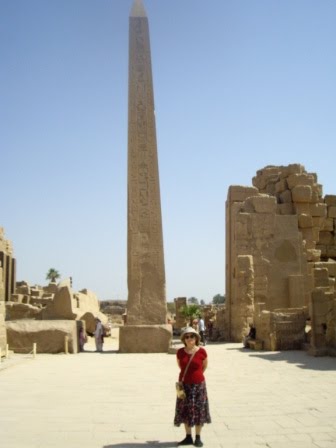
We spent two days in Luxor walking or rather rushing from one temple to another until I begged our guide to slow down. We could have easily spent four days for a more relaxed tour of the monuments.
[Click on pictures to enlarge]


We also attended a sound and light show at the temple of Karnak.


In the time of the Pharaohs, Luxor was called Thebes, the most important capital of the civilized world.


In addition to the Temple of Luxor and the Temple of Karnak, Luxor boasts the famous Valley of the King that harbored more seventy tombs, including the tomb of Tutankhamen—famous King Tut. It is assumed that many more tombs are still hidden under the desert in this area. We visited four of the tombs going down the steps under the rock to admire the incredibly well preserved sculptured and painted walls. Unfortunately we were
not allowed to take pictures.


The Temple of Luxor—dedicated to Horus, the falcon-headed god-- was connected to the temple of Karnak by a causeway of sphinx.


The temple of Luxor was built by Amenhotep III and later by Ramses II and had two obelisks. One of them was donated by Egyptian ruler, the great Mohamed Aly to France and is now in the Place de la Concorde in Paris in 1819.

The temple of Karnak was built 2000 years ago. It consists of ten pylons and four courtyards. The Hypostyle has 134 columns.


Many festivals were celebrated in Thebes such as the festival of Opet. The festival itself was to reconcile the human aspect of the ruler with the divine office. The festival lasted eleven days, but had grown to twenty-seven days by the reign of Ramses III. At that time the festival included the distribution of over 11,000 loaves of bread, 85 cakes and 385 jars of beer.


The procession of images of the current royal family began at Karnak and ended at the temple of Luxor. The journey was being made by barge, on the Nile River. Each god or goddess was carried in a separate barge that was towed by smaller boats. Large crowds consisting of soldiers, dancers, musicians and high ranking officials accompanied the barge by walking along the banks of the river.


During the festival the people were allowed to ask favors of the statues of the kings or to the images of the gods that were on the barges.


If you like to travel and love to read, come and enjoy my international romances. I will take you around the world through stories that simmer with emotion and sizzle with heat~

BABIES IN THE BARGAIN, winner of 2009 BEST contemporary romance at READERS FAVORITE and 2009 BEST ROMANCE NOVEL at Preditors & Editors Readers Poll.
Rx FOR TRUST: 5 stars at Readers Favorite.

Monday, April 26, 2010

Queen Hatshepsut

In the old city of Thebes, the capital of strong kings and rulers called Pharaohs, an unthinkable thing happened in 1515 B.C., a mere female seized the throne. She dressed as a man, built a temple and had the people honor her as Pharaoh.

Queen Hatshepsut is the only female Pharaoh to have ruled over Egypt. When her father, Pharaoh Tuthmoses I died, her younger brother, Tuthmoses II, became Pharaoh. In Ancient Egypt, the women couldn't reign but tradition had it that only the women in Egypt carried the royal blood, not the males.


(Hatchepsut built this temple to the goddess Isis, goddess of fertility. She represented herself as a male Pharaoh.)


(Below: Pharaoh presening gifts to the god Horus (with the head of a falcon.) This god guided the dead to the afterlife in the boat of death. The colors are still
great after 3500 years and were made with egg white.
To become Pharaoh, the man had to marry a female of royal blood, often a sister. Tuthmoses II married Hatshepsut, gave her a daughter, and died young. His son by another wife, Tuthmoses III, was still a child.

Hatshepsut became regent. They ruled together for a number of years until she proclaimed herself Pharaoh, something almost unheard of, despite the higher status of women in Egypt compared to women in other cultures at the time.
Before Hatshepsut, there were queens who had ruled Egypt... but not a female Pharaoh.
(Here Hatshepsut dressed as a male Pharaoh).
She managed to rule for about twenty years, before disappearing from history... coinciding with Thuthmose III's becoming Pharaoh in his own right. He erased her name from all the scriptures.

Later, the Christian monks built the monastery of Deir El Bahari, next to Hatshepsut's Temple.


If you like to travel and love to read, come and enjoy my international romances. I will take you around the world through stories that simmer with emotion and sizzle with heat~

BABIES IN THE BARGAIN, winner of 2009 BEST contemporary romance at READERS FAVORITE and 2009 BEST ROMANCE NOVEL at Preditors & Editors Readers Poll.
Rx For Trust: 5 stars at Readers Favorite.